Primer programa de esta nueva aventura, donde hablamos de Leo P, los Rolling, la película “El cuento de los cuentos”, “Samantha Darko”, etc. en nuestras secciones: “Una de cal y una de arena”, “El callejero musical”, “Lo Oculto”, “Acontrahecho”, “Are you ready for this?: El noticiero”, “La Agenda” y muchas más sorpresas que descubrirás escuchándonos. […]
How Artificial Intelligence in Sales is Changing the Selling Process You will also need to check the results of AI to ensure they’re accurate and fit into your sales strategy. To establish the best requirement, engage with your sales managers … Sigue leyendo →
Building Intelligent Chatbots with Natural Language Processing On the left part of the previous image we can see a representation of a single layer of this model. This post only covered the theory, and we know you are hungry for seeing … Sigue leyendo →
Content warning: This text involves talking about sexual violence and death.
In August 2023, we, anarchist organisations from five continents, launched an international solidarity campaign. Its aim was and is to support Sudanese anarchists fleeing war and repression in their country and to ensure that they arrive safely in a destination country of their choice. Six months have now passed since our first call for solidarity. In this short text, we would like to report on the current situation and the continuation of our campaign.
First things first: the majority of the small group of anarchist comrades with whom we have been in contact since 2022 and whom we have been supporting in their journey into exile since last year have now managed to leave Sudan. A small number of comrades is still in the country and is part of the resistance committees in Sudan. Among other things, they are working to support displaced people. The resistance committees help women in refugee camps to form their own committees to defend themselves. They also organize independent activities for children and young people because there is currently no school due to the war. But working under the military emergency law is dangerous. Our comrades on the ground need support to leave the country, because the political situation for activists and revolutionaries is increasingly uncertain and there are many arbitrary arrests. A terrible piece of news that recently reached us showed just how dangerous the situation is: In her attempt to flee the capital Khartoum, our comrade Sarah was raped and murdered by members of the Rapid Support Forces (RSF). We share the deep pain of our comrades over this loss.
The fact that we have been able to carry out international solidarity work at all - albeit on an extremely limited scale - is thanks to the great support of many organizations and individuals from all parts of the world. With their help we have been able to significantly exceed the original donation goal of 2000 US dollars. We would like to take this opportunity to express our warmest thanks to all those people who have supported this campaign and put their solidarity into practice!
However, the costs of our project have also significantly exceeded expectations. The main reason for this is the extremely unstable and worsening situation in Sudan. The war between the Sudanese army and the RSF militia has been going on for almost a year now. The fighting intensifies with each passing month. Over 14,000 people have already been killed. More and more parts of the country are being drawn into the fighting, more and more blood is being shed, more and more people are being displaced. Mass exodus and war have led to an unbearable famine that is worsening every day. The lives of hundreds of thousands of people are acutely at stake. It is a game that is also being played by international actors. The weapons used by the RSF against the civilian population are partly funded by the European Union. The EU deployed the militia as a border force in the service of its migration defense for at least a few years, has been arming them for this purpose and is very likely still doing so (1,2). Currently, there are in increasing indications that the United Arab Emirates, for example, are supplying the RSF with sophisticated weapons systems to keep the war going (3).
In addition to the war in their own country, the repressive border regimes of the surrounding countries also make it difficult for our comrades to flee Sudan. The prices for VISAs to enter the northern neighboring country of Egypt, for example, have skyrocketed. The few remaining transportation routes have also become enormously more expensive. A large part of the money raised by the campaign has therefore already been spent. We need more money to enable our last comrades to flee Sudan and to finance the continuing journey of the other comrades. We will therefore be stepping up our efforts for the campaign once again in the coming months. In some regions, our organizations will spread the campaign, which has so far mainly had a digital presence, even more widely on the ground. We also want to draw attention to the general, catastrophic situation of the people from below in Sudan and help to break through the blanket of silence that the governments and their press have prepared over the events there.
We call on all trade unions, social and political organisations and all individuals in solidarity to stand with the Sudanese anarchists and continue to support the campaign. Spread the word in your organisations and movements. Use all public channels available to you. Donate to the campaign. Every form of help counts.
Unite against war and repression!
International solidarity with the Sudanese anarchists!
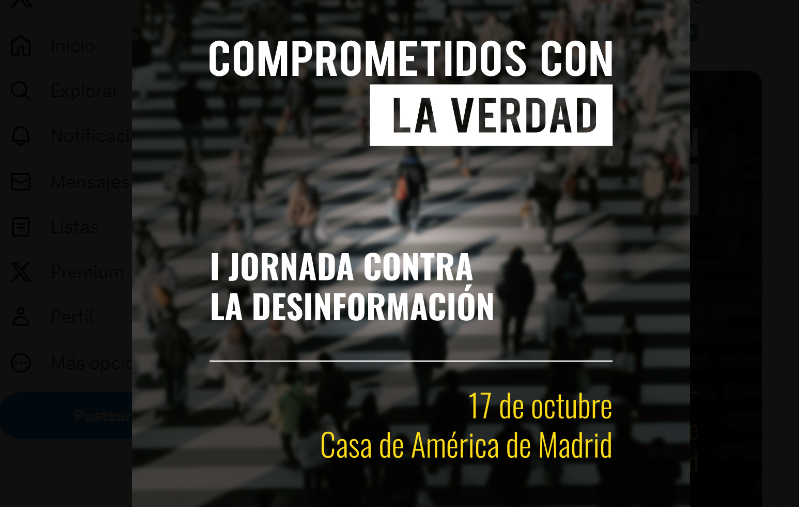
El Club Abierto de Editores (CLABE), (@clabe_editores), celebra mañana 17 de octubre, en la Casa de América de Madrid, la ‘I Jornada contra la desinformación’ una iniciativa pionera en la lucha por la verdad y la autenticidad informativa. Bajo el lema ‘Comprometidos con la verdad’, el evento pretende abordar la problemática de la desinformación y sus implicaciones en la sociedad actual.
El evento contará con la participación de expertos en la materia como son: Martyna Bildziukiewicz (@MBildziukiewicz), jefa grupo trabajo East Stratcom (@eu_eeas), Comunicaciones estratégicas; Fernando G. Urbaneja, (@fgurbaneja), Presidente de la Comisión de Arbitraje, Quejas y Deontología del Periodismo de FAPE; Virginia Pérez-Alonso, Vocal de la Junta Directiva de CLABE y Directora de Público (@publico_es)
; Juan Zafra (@prensa14), Director General de CLABE; Rosalía Lloret, (@rlloret) Directora General de eldiario.es; y Raúl Magallón (@raulmagallon), Profesor del Departamento de Comunicación de la Universidad Carlos III, reconocido autor de ‘Unfaking News. Cómo combatir la desinformación’ y ‘Desinformación y Pandemia‘ y reponsable de la elaboración de la Declaración en defensa de la calidad democrática y cultural. Contra la Desinformación’ que se presentará en el evento.
En el marco de la I Jornada contra la desinformación presentamos la 'Declaración en defensa de la calidad democrática y cultural. Contra la Desinformación'.
El texto lo ha elaborado @raulmagallon, profesor @uc3m e investigador en este ámbito
El programa abordará una amplia gama de temas críticos, desde el papel de la tecnología en la propagación de la desinformación hasta la responsabilidad de los medios de comunicación en la promoción de la alfabetización mediática, así como la perspectiva europea, la desinformación durante los conflictos, el compromiso y el papel de los medios de comunicación, y cómo aborda la UE la desinformación. La participación de estos destacados expertos promete enriquecer el debate y promover iniciativas de interés de cara a la búsqueda de soluciones efectivas para abordar esta problemática.
News about the latest militaristic and repressive measures has been flowing in such a stream for weeks that it sometimes interrupts attention to events at the front. There is an increasing impression that the Kremlin and the Office of Zelensky are starting to fight not so much with each other, but with those who do not want to fulfill their “duty to their homeland.” The Ukrainian parliament will soon consider bill No. 10062 on a unified electronic register of conscripts and those liable for military service – modeled on the neighboring chamber, where summons will now be considered served from the moment they appear in it. The Ministry of Defense allowed to draft into the Armed Forces of Ukraine those who are of limited fitness due to hepatitis, cured tuberculosis, asymptomatic HIV, mental problems, etc. Bill No. 9672 proposes to cancel the deferment from the army for recipients of the second higher education, post-graduate students and those who first attended the university after 30 years. Doctors are being stormed with large-scale checks for trading in disability documents. Women from among medical staff and pharmacists will be registered with the military from October 1st, and those who have a military record will have to update their data; after the launch of the e-register, they can be screened out when trying to leave Ukraine. Threats of extradition and punishment to men who went abroad, deceiving the authorities (as the authorities themselves did to them all their lives). The Border Guard Service of Ukraine has already begun to publicly show “educational work” with violators of the western border, forcing them to listen to the anthem and the priest’s sermon, after which they are handed over to the enlistment officers. To detect such citizens in the bushes, the border patrols began using drones with thermal imaging cameras, supposedly so necessary for the front. Then, presumably, they will start to drop grenades or hunting nets on the migrants. In turn, the deputy head of the Russian Guard in Donetsk, former separatist field commander Alexander Khodakovsky called for the creation of barrier detachments for Russian soldiers – because “many are ready to wait from prison for their loved one, who threw away their weapons and refused to fight, just so as not to die.”
Against such an informational background, the story of a Kharkov resident at the military recruitment office of Staryi Sambir in the Lviv region received a huge resonance. This is not the first time that they tried to send into the army those captured trying to escape from the “country of dreams”, this time the mobilizers just did a little less work and video records were transferred to bloggers, instantly exploding social networks with anger. The inmate was kept there from September 12th to 19th, beaten on the head with a pistol, starved, not provided with medical care, threatened with death and that “the police would not look for him.” Even before this video, hardly many people doubted that the cops act in conjunction with the enlistment kidnappers, while the State Bureau of Investigation reported on the 19th that the deputy chief of one of the departments in the Sambir districtal recruitment center and its driver are detained. They face up to 10 years in prison under Part 3 of Art. 406 of the Ukrainian Criminal Code (violation of statutory rules, relationships by military personnel using weapons). The Bureau requested that both be taken into custody without bail; the court in Lviv sent them under round-the-clock house arrest for 2 months. The National Agency on Corruption Prevention has found suspicious property worth 4.4 million hryvnias owned by the chief of the same facility. Of course, even if they are found guilty and imprisoned, it will not change anything systemically – power corrupts, and absolute power corrupts absolutely.
The investigation established that the suspects illegally detained at least two men – residents of Kharkov and Krivoy Rog. After being detained by border guards during unauthorized crossing the border with Poland, they were taken to the enlistment office, where the servicemen tried to force them to go through the medical examination. One of these refusers was kept for 10 days, another one for 7 days.
The resident of Krivoy Rog says that his name is Roman Kuzmenko, born November 12, 1985. Our compatriot is 43 years old and he was hospitalized with a concussion; he introduces himself as Vadim Spokoynyi (Ukrainian spelling – Vadym Spokiynyi). “Vadym is an animator. His stage name is Max. The first weeks Vadym was in Kharkiv – he volunteered a lot, helped people, tried to entertain children in bomb shelters so that they would not be so sad and scared. Later, he moved to Staryi Sambir with his acquaintance Dina. They didn't have a home here, so they temporarily lived in a van near the river. I helped them find accommodation. Later, his father also moved in with Vadym, he has a disability, does not walk much, is practically bedridden. His father somehow found the strength to come to the Military Commissariat. But they didn't let him in. They didn't even let me see each other. It's terrible. He is not a criminal and is not in a pre-trial detention center”, his local comrade Sofia Ryzhenko told the LMN newsletter. She does not know whether Vadim has official guardianship over his father. “Can you imagine what it's like to be an animator and work with children? He is very kind, harmless. Well, how can you force a person to sign that he will go to war, if he is afraid of it or cannot?”, the girl asks a rhetorical question. The fact that he, with such a peaceful character, showed an iron will and managed to withstand many days of attempts to break him is what is most shocking in this situation.
Those living in Staryi Sambir note that this is not the first case of such imprisonment of citizens by the enlistment officers. And, as a Kharkov resident named Ivan shared with us on September 20th, hell was going on there long before the full-scale Russian aggression:
“I got into this recruitment center in 2016. I almost got beaten there too. Barely escaped. They even wanted to send me then to the ATO [Anti-Terrorist Operation, the official name for hostilities in Donbass], despite the fact that I had a referral for a surgery in Kharkov. They said I didn't need surgery. I was registered there, went to sign up through the enlistment office, I had documents that I was undergoing surgery, and receipts for payment. Two drunk doctors came (like a medical commission). They said I didn't need surgery. They decided so without practically examining it. They said that the ATO would be just right for me, since I go to the gym and am in good physical shape. I said that I would probably refuse and am informed a little about my rights. They fucked my brain for a very long time and didn’t hand over the documents, and I also communicated in Russian. This really threw them up. Military commissars generally communicated as with cattle. Like you're pissing to go to the ATO, etc., etc. Although they themselves saw this ATO only on television. Something like this, in short.”
The Ukrainian public is more and more asking the question: how does this state with such everyday practices differ from the Russian one? In particular, Yevgenia, the wife of the Russian mobilized Yevgeniy P. from military unit 61899, turned to the Russian liberal pacifists ASTRA. For refusing to go to the assault with injuries, he and other soldiers were sent to the basement in Zaytsevo (a village controlled by the so-called “Lugansk People’s Republic” near the Kharkov region), where they are threatened and forced to continue fighting. The detainee told his wife about this on September 18th by phone, after which contact with him disappeared. In May, in Bakhmut, he received a fragment wound in the leg, due to which he was sent to the hospital. However, Yevgeniy was not given aid there; the fragment was not removed, his wife says. He was sent home for rehabilitation for a month. A month later, the commander changed, the new one sent a unit to Naro-Fominsk near Moscow. The entire company with wounds was locked in the barracks and kept there for a week. The surgeon then concluded that they could all continue to fight despite their injuries. They were taken in the direction of Svatovo and abandoned in the forest without any means of subsistence. “My relatives and I cut off all the hotlines, reached the head of the unit, but our requests and prayers for the salvation of the guys are simply ignored, citing the fact that, they say, there is a war, etc. This is just madness and absurdity, the boys with wounds were thrown just like cannon fodder!”, the woman told this media.
Ukraine is a prison of the people. Russia is a prison of the peoples. That's all the difference.
La tercera edición de la Cumbre Global sobre Desinformación reunirá virtualmente a más de 20 destacados oradores internacionales durante los días 27 y 28 de septiembre con el objetivo de abordar la creciente amenaza que representan las «fake news» para la democracia.
El evento, online y gratuito, y contará con la participación de más de 30 países. Periodistas, investigadores, académicos, fact-checkers, medios de comunicación, representantes gubernamentales, organizaciones de la sociedad civil, profesores y estudiantes se darán cita en este encuentro sobre la amenaza de la desinformación.
La Cumbre Global sobre Desinformación ha sido un evento de gran relevancia en años anteriores, y este año no será la excepción. La Sociedad Interamericana de Prensa, (@sip_oficial), el Proyecto Desconfío de Argentina, (@DesconfioA) y la Fundación para el Periodismo de Bolivia, (@Fperiodismo), organizadores del evento, tienen como objetivo proporcionar un espacio de reflexión y debate en torno a los desafíos actuales a los que se enfrenta la sociedad en el ámbito de la desinformación.
Durante los dos días de la cumbre, se abordarán cinco ejes fundamentales:
Desinformación electoral: un desafío para la democracia.
«If It doesn’t spread is dead»: el reto de construir estrategias eficaces para la distribución de contenidos verificados.
Recuperar la confianza en la era de la desinformación: construyendo indicadores de calidad de las noticias.
Verificación en la era de la IA: retos y soluciones.
Media literacy: alfabetización de las audiencias en tiempos de Tik-Tok.
«La idea de estar informado, pero, sobre todo, de sentirse bien informado en este momento está en entredicho», nos expica Raul Magallón, (@raulmagallon ), periodista, escritor y profesor de periodismo en la Universidad Carlos III de Madrid, hablando de su nuevo libro: UPDATING NEWS: Información y democracia.
Un nuevo trabajo que quiere ir un paso más allá, y tratar de explicarnos: «¿Por qué en este momento resulta más complicado reconocer la verdad si nuestro conocimiento sobre lo que somos es mucho mayor de lo que había sido nunca?
R.M- Más información no ha traído un mundo donde nos sintamos mejor informados, pero tampoco un mundo donde más información sea sinónimo de un mundo más democrático. La fatiga informativa, el papel de las redes sociales en la economía de la atención y su capacidad de viralizar lo emocional y el lugar de la desinformación como una disfunción normalizada e integrada en el sistema son algunas de las consecuencias más evidentes de esta situación. Por otra parte, la búsqueda de la verdad es un proceso mucho más complejo y aburrido que requiere más tiempo y tiene más matices que las narrativas que pretenden desinformar apelando a las emociones y buscando atajos intelectuales.
P.G- ¿Qué papel crees que jugará la desinformación en las elecciones a la Asamblea de Madrid, del próximo 28 de mayo?
R.M– La desinformación funciona mejor en escenarios de incertidumbre y desconfianza creciente en el sistema. En este sentido, los ciclos de actualidad determinan las narrativas preferentes de cada campaña electoral, si bien es cierto que hay narrativas globales que se adaptan a contextos locales. Por otra parte, es importante que los actores, organismos e instituciones encargadas de velar por el buen funcionamiento de la máxima representación de la democracia que son las elecciones sean capaces de ser ágiles, transparentes y capaces de transmitir confianza ante cualquier cuestión relacionada con el proceso electoral. En cualquier caso, son elecciones locales y autonómicas que no sólo se celebran en Madrid sino en todo el país y, por lo tanto, tienen sus propias lógicas locales y particulares que a veces coinciden y, otras muchas, compiten entre sí.
P.G- ¿De qué forma consideras que: «los sistemas democráticos están perdiendo la capacidad de creer en ellos mismos».
R.M- Los países que viven en democracia han disminuido en la última década. Los distintos informes que intentan medir la calidad democrática de los países coinciden en el diagnóstico. Por ejemplo, los datos de The Global State of Democracy Report del año 2022 destacaban que, entre 2016 y 2021:
el número de países que se dirigían hacia el autoritarismo era más del doble del número de países que habían avanzado hacia la democracia.
(Raul Magallón).
R.M- Durante ese período, 27 países experimentaron una rebaja en su clasificación, mientras que solo 13 mejoraron.
P.G-¿A qué te refieres cuando hablas en el libro de «El acontecimiento mediático como catalizador político»?
RM- Cada generación tiene en su imaginario y en su memoria social y colectiva una serie de acontecimientos mediáticos e históricos que sirven de punto de referencia común, que aportan sentido a un pasado común y que establecen puentes y diálogos entre las historias personales y las colectivas. Lo que hemos visto con el asalto al Capitolio en EEUU o el intento de asalto de los tres poderes en Brasil, es que hay determinados acontecimientos que intentan activar determinadas respuestas políticas y sociales. Podemos pensar que son fenómenos aislados, pero también que el populismo no sólo tiene memoria sino que a partir de esa memoria ejercitada puede crear estrategias y tácticas cada vez mejor diseñadas a nivel global.
PG- ¿Qué papel juega, en este nuevo ecosistema informativo la irrupción de la Inteligencia Artificial?
R.M-Si pensamos desde el punto de vista del consumo informativo, una de las grandes diferencias entre el nacimiento de internet y la emergencia actual de la inteligencia artificial es que, en la actual economía de la atención, ésta no solo compite con internet o la televisión, sino que está en competencia con un mercado de la atención cada vez más saturado. Sin embargo, si pensamos en la IA como una tecnología disruptiva creo que puede ser muy útil a la hora de encontrar patrones en grandes bases de datos, estructurar mejor las ideas y también a la hora de explorar futuros posibles. Ahí considero que nos puede ayudar, estableciendo distintas posibilidades para interpretar las consecuencias futuras de determinados hechos y acciones y poder adaptarnos más rápidamente a ellas.
R.M- Si cogiéramos una estimación moderada del tiempo de uso de redes sociales por parte de nuestros jóvenes, unas cuatro horas diarias, tendríamos un total de 1460 horas anuales de consumo de redes sociales. Pensemos que se estima que un estudiante de secundaria pasa entre 1000 y 1050 horas anuales en clase. Es evidente que si nuestros jóvenes pasan más tiempo en redes que en clase,
necesitamos integrar la formación sobre las posibilidades, riesgos, limitaciones, etc. de esas redes en el curriculum escolar. No se entiende cómo no hemos podido integrar formalmente una sola hora de docencia para explicar una cuestión tan importante.
(Raul Magallón).
R.M- Los representantes políticos hablan de proyectos concretos, iniciativas particulares, etc. pero hace falta un plan mucho más ambicioso y un compromiso colectivo real.
P.G-En el último capítulo del libro señalas: «La última década no tuvo lugar porque no pensamos en cómo imaginar juntos la siguiente», qué quieres decir con eso exactamente.
R.M.- En realidad, es un guiño al sociólogo Jean Baudrillard que escribió en los años 90 “La Guerra del Golfo no ha tenido lugar”. Fue una expresión provocadora que no buscaba negar la realidad de la guerra sino todo lo contrario, explicar la importancia de los medios a la hora de configurar y marca la realidad compartida y la percepción de lo socialmente relevante. Aunque con matices, sigue teniendo vigencia la idea de que lo que deja de verse en los medios deja de tener relevancia social. En la última década hemos hablado mucho del papel de las redes sociales, de la perdida de confianza en los medios de comunicación, de una tecnología que nos iba a permitir aumentar el número de países democráticos en esos rankings, de las posibilidades para luchar contra la desigualdad de la globalización, etc. Sin embargo, la realidad es que hay -al menos- una generación que está determinada por la crisis de 2008, la pandemia y ahora las consecuencias de la guerra en Ucrania y el consiguiente aumento de las desigualdades. Explorar las posibilidades democráticas de la próxima década pasa por establecer otro tipo de criterios más tangibles y también por tener el horizonte de expectativas mucho más claro sobre cómo reducir esas desigualdades, generar una mayor igualdad de oportunidades y aumentar el número de personas y países que confían en la resiliencia, eficacia y fortaleza de los sistemas democráticos.
P.G- ¿A quién le recomendarías leerlo?
R.M- La idea principal del libro es explorar los principales relatos y narrativas que nos han llevado a pensar que nos sentimos peor informados, que los sistemas democráticos ya no son tan atractivos socialmente y establecer un punto de partida para salir de esa dinámica de incertidumbre y desconfianza. Creo que es un libro que conecta con la percepción de un diagnóstico compartido en torno al momento actual y que puede plantear desafíos intelectuales e interrogantes comunes. El objetivo del libro no es tanto que el lector pueda obtener respuestas, sino que genere nuevas preguntas y matices sobre algunas cuestiones en ese lector.